
For those who love maps, let me encourage you to pull one out and follow along. These last three weeks in Uganda have gone by in a whirlwind.
If you are following along on that map, Jinja serves as home base for me. One place that captures the rhythm and energy of the city is Jinja Central Market, a large market where vendors sell to passersby as people move from floor to floor.
The market is constructed somewhat like two adjacent parking garages, with vendors spread across multiple levels. Yet it does not feel empty or cavernous. Instead, it is alive with the hustle and bustle of people as vendors show off their wares.
Vendors often step out from their stalls to engage you directly, inviting you into their space and letting you know what they have available. Sometimes that sounds something like this: “I have peas! Madam, Come!” The goal is to draw you closer and encourage a purchase. If you keep walking, they may follow you for a short distance, hoping you might reconsider. Bargaining usually only begins if you signal that you are hoping for a lower price.
In the end, the price per pound may come down if you agree to purchase more than you originally planned—perhaps a half-pound bag instead of just a cup of peas.
Honestly, I love peas.
While we’re on the subject of small everyday details, here is a fun fact about Uganda: the soil here is a deep red clay that easily stains floors and is quickly tracked indoors. Because of this, it is common in many homes to remove your shoes at the door and switch to a pair of inside shoes.
Which brings me to something I purchased at the market today, a pair of shoes.
Haggling the price was rather interesting as vendors approached us to purchase their products. My friend and I wove in and out of the stalls until one young man noticed me looking at a pair of sandals. He asked in Luganda what I was looking for, and my friend translated that I needed something with soft heels for inside shoes.
He encouraged us toward his stall, where I noticed a pair of Crocs. They were too big but looked intriguing.
We sat there watching as the surrounding vendors began searching for exactly the pair I wanted in my size. Once they found them, the bargaining began.
“58,000 shillings.”
“No, 50,000.”
“I can only go 55,000—last offer.”
“Deal!” I offered him my hand to shake his, the deed was done! 55,000 shillings—about $15 USD.
From Jinja, the week often takes us into surrounding communities such as Kitimbwa, Bbaale, Nazigo, and Kyunga, each part of the wider region beyond the city.
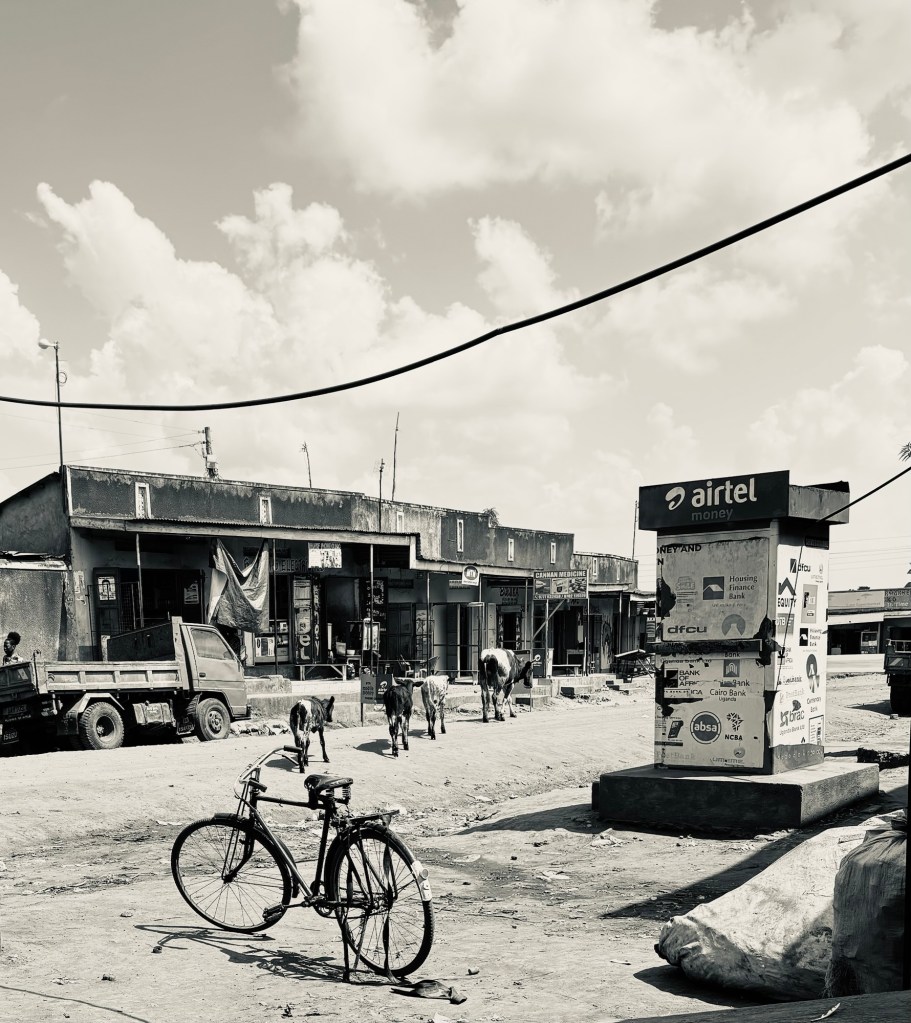
In Nazigo, the market is much smaller. While I was there, cows casually crossed the road as people continued about their day.
In Kyunga, a hospital is in the early stages of construction. What stood out most was the scaffolding—constructed not from metal but from eucalyptus trees grown in nearby groves. The trunks are cut and nailed together to form tall wooden frames. From this wooden lattice, brave and steady men climb and work as they build the hospital floor by floor, shaping much of it by hand or with simple hand-held tools.
Throughout the week, I also have the opportunity to go into the field with the Imprint Hope team. While parents meet with staff members, therapists, and nutritionists, I spend time playing with the children so their parents can focus on the conversations and guidance that support their families. These moments are often simple—sitting on the ground with toys, sharing a laugh, or helping keep little hands busy while important conversations take place nearby.
During these visits, I also help document parts of the work by taking photographs that are submitted to Imprint for their internal use.
Another part of my time here has been dedicated to a creative project: painting a mural for Imprint Hope. It has been a meaningful way to contribute my artistic skills while helping create a welcoming space for the families and children who gather there.
What I admire most about this opportunity is the chance to observe the grit of these families, regardless of their circumstances. Each family has their own story—many of which can be found on Imprint’s social media—and each one is unique. What stands out to me is their determination to keep moving forward, even when the circumstances they face feel overwhelming.
Whether single or surrounded by community, these individuals do not give up or surrender the ground they have gained.
I am loving it here and am so grateful to participate in every aspect of this journey.
Note to Friends and Family:
Friends and family, a quick note: while I may share about traveling into the field, I will not include names or photographs of those Imprint serves so that their dignity and privacy remain protected.
If you would like to see more of the work being done here, I encourage you to visit Imprint’s Instagram, Facebook, website, and YouTube channel. I’ve hyperlinked each for you above so you can follow along with the work being done and learn more about the beautiful nation of Uganda.

 Lightly Woven Ink
Leave a comment